Monday, April 15, 2013

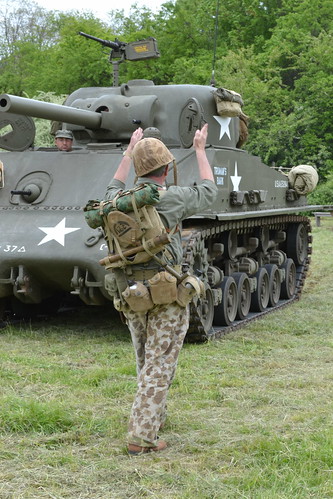
2013 World War II Encampment, May 18 to May 19 at Old Bethpage Village Restoration

I heard from one of the event organizers that this event will be bigger than before.

Operational WWII U.S. vehicles & equipment will be present including: M4A3 Sherman, M5 Stewart M8 Greyhound, M20 Armored Car, M3 Scout Car, Weapons Carriers, Jeeps, 155mm Long Tom Howitzer, 40mm AA gun, .50 cal Quad Mount & 57mm AT Gun.

Old Bethpage Village Restoration is located at 1303 Round Swamp Road, Old Bethpage, Long Island, NY

They are also looking for even more participants to portray WW2 Allied personal, militaryor civilian. For further info. contact : Jim Michaud or Jim Lennon

A photo from the 2011 event (I didn't make it to 2012):

'Momback

Click here to visit the Long Island Living History Association facebook page.

Labels: , , ,

Thursday, April 26, 2012

Genealogy Research - How to look up New York City Death Certificates

How to look up New York City Death Certificates

Death certificates can be important resources for anyone interested in their family history. You can find information about a deceased ancestors parents, residence and other info.

If you have a relative's name and approximate date and/or location of their death you can look up the death certificate number on italiangen.org. It's okay if you're not Italian, they have a substantial index (which is searchable) of NYC death certificates. If too many people come up in your search with the same name and you're not sure which is your relative, you may need more information to narrow it down.

Once you do get the death certificate number, you can order it from the LDS Church (just as Italiangen is not just for Italians, the LDS Church records service will serve everyone), or you can order it from New York City Department of Records (but it is more expensive). Records from the LDS Church are $2 (minimum order is $4) and the NYC Dept of records is $15 per record, if memory serves. I have used both and you can use either one.

To order from the LDS Church you need to know the microfilm number that the certificate is on. To find the microfilm number go to this website:

https://www.familysearch.org/eng/library/fhlc/

Click on "Place Search" and search for "New York." Click on "New York, New York (City)" and scroll down until you find "New York, New York (City) - Vital records", probably on the next page. Now look for "Death certificates (Manhattan, New York), 1919-1948", after clicking that look in the upper right for a button that says "View Film Notes."

You will then see date ranges and certificate numbers for each of the film numbers. Be aware that the certificate numbers may go back to "1" for each year, make sure your looking at the right date range. Hit the "Next film notes" button at the bottom to go to the next set of films. They're in date order. Note down the film number (FHL US/CAN Film) once you find it.

Now you need to find the "Request for Photocopies; Census Records, Books, Microfilm or Microfiche" form. At the time of this writing you can find it here:

http://www.familysearch.org/ENG/Search/RG/frameset_rg.asp?Dest=G1&Aid=&Gid=&Lid=&Sid=&Did=&Juris1=&Event=&Year=&Gloss=&Sub=&Tab=&Entry=&Guide=FReqMicrofilm.ASP

Fill your address, email, phone, payment info etc on the first page. On the second page you are looking for the "General Microfilm or Microfiche" section. In the first column, enter the microfilm number. in the name column, put the name. In the widest column put "Death: NY, NY", put "D" in the next column, the date of death in the next column, "NY,NY" in the next column and the Death Certificate number in the last column. Ignore any columns I did not mention. Remember the minimum order is $4 and the records are $2 each, so it makes sense to request two different certificates at once if you have information and the inclination. Put your payment and the forms in an envelope and mail them off to the photoduplication unit.

That's it! Remember this is going by mail and coming back by mail. And someone has to look through a microfilm reel to find your record so it may take a few weeks or more.

Labels: , , ,

Friday, January 13, 2012

Red Tails: Victory On Two Fronts


Red Tails comes out in theaters on January 20, just one week from today. It tells the story (in an action-drama format) of the Tuskegee Airmen, the first African American pilots to serve the United States. Executive Producer George Lucas brings the story of these heroic fighter (and later bomber) pilots to the bring screen. These men went to war for our country and fought against a terrible evil in Europe despite the discrimination they faced in their own home towns. As dramatic and full of special effects as the movie is you have to remember that these were real men and what they did was incredibly brave in a number of ways.

Coincidentally to the movie coming out, Dover Publications has just republished a book called Red Tails: An Oral History of the Tuskegee Airmen by John B. Holway. The book is based on interviews with these courageous men.

Labels: , ,

Friday, March 25, 2011

Did You Know: Rag Paper vs Wood Pulp Paper

Excerpted from http://www.cycleback.com/printsexamination/sixteen.html

Rag versus wood pulp.In the early history paper was made from rags.Starting about the mid 1800s, rag pulp began to be replaced by wood pulp.Wood became a popular choice due to the scarcity of rags and because wood pulp paper was cheaper to manufacture.The first successfully made American wood pulp paper was manufactured in Buffalo, New York, in 1855. By 1860, a large percentage of the total paper produced in the U.S. was still rag paper. Most of the newspapers printed in the U.S. during the Civil War period survived because they were essentially acid-free 100% rag paper, but the newspapers printed in the late 1880s turn brown because of the high acid content of the wood pulp paper. In 1882, the sulfite wood pulp process, that is still in use today, was developed on a commercial scale and most of the high acid content paper was used thereafter in newspapers, magazines and books.

Counterintuitively, modern paper, especially in books, letters and newspapers, is much more likely to turn brown and brittle than paper from before the American Civil War. For the beginning collector, the paper on an early 1800s print can be surprisingly fresh and white.

Labels: , , , ,

Thursday, March 17, 2011

Consering and Preserving Documents and Artifacts at the Imperial War Museum

All of these images are from the conservation lab at the Imperial War Museum

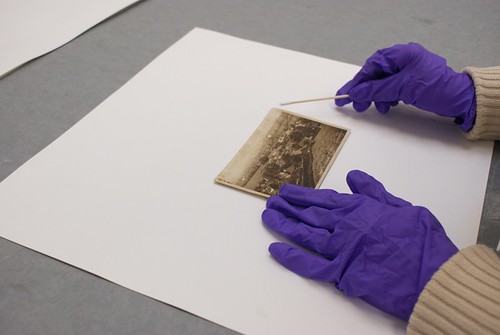
Cleaning a photo

Cleaning a photo
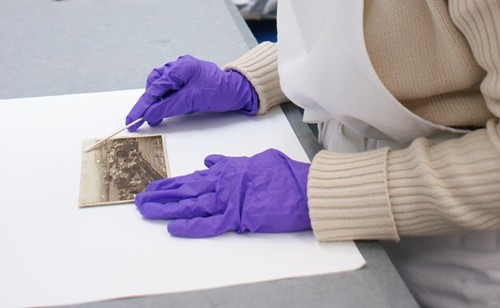
To clean the surface of the photo, Tina carefully rolls (never rubs) a swab across it to pick up any dirt or dust.

Repairing a photo

Repairing a photo
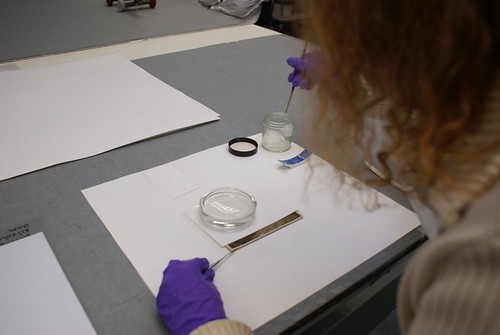
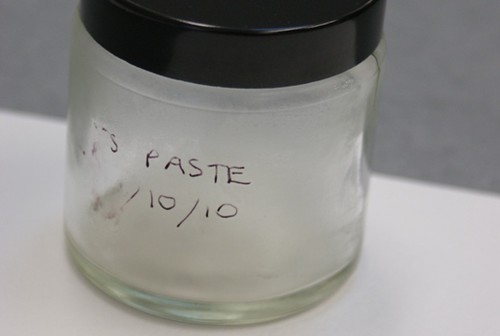
Any small rips or tears in the photographs are repaired using wheat starch paste

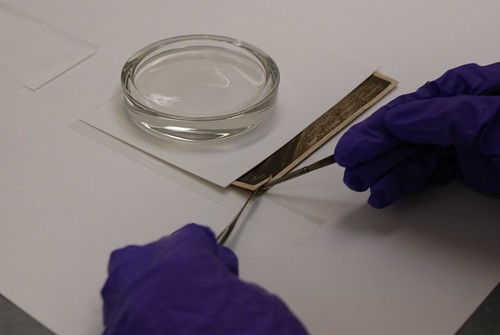
Repairing a photo step 2

Repairing a photo step 2
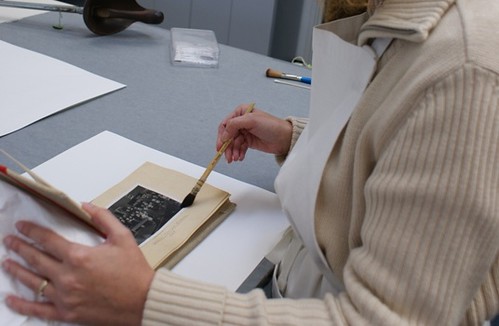
The paste is applied to the card mount, not the underside of the photo surface, so that the card can absorb the excess moisture in the paste.

Photo consevation in action

Photo consevation in action
Conservator Tina Kelly working on a photo album that will appear in the exhibition. The cushion is used to support the cover of the album when condition reporting. Without the cushion, which is actually more like a bean bag that can be squished the required shape, the spine could break.

Get yer gloves on!

Get yer gloves on!
Gloves must be worn when handling photographs as fingerprints can damage the gelatine that forms the surface of the photo.

Wheat starch paste

Wheat starch paste
Don't eat this in class...

------------

Sword cleaning

Sword cleaning
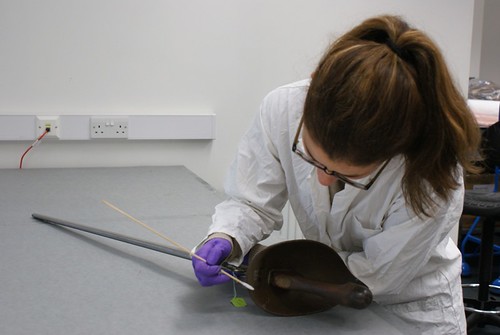
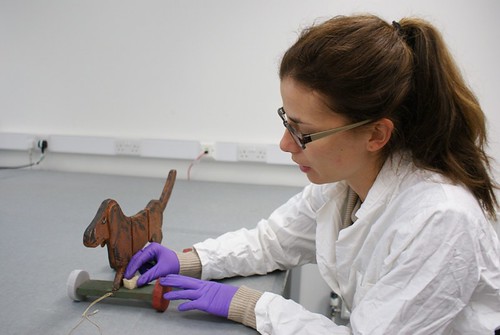
Conservator Heidrun Gassner cleans a British cavalry sword, dating from around 1908, with a solvent (acetone) to remove any grease.

Sponge bath

Sponge bath
However, acetone should not be used on painted surfaces. Instead, a sponge is used to clean off any surface dirt.

--------------

Tearing

Tearing
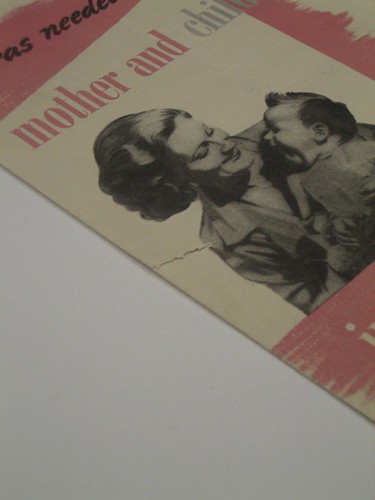
Old paper is fragile and easily damaged, so any tears must be repaired before an item is handed over to the Exhibitions team for installation in a showcase.

Repairing

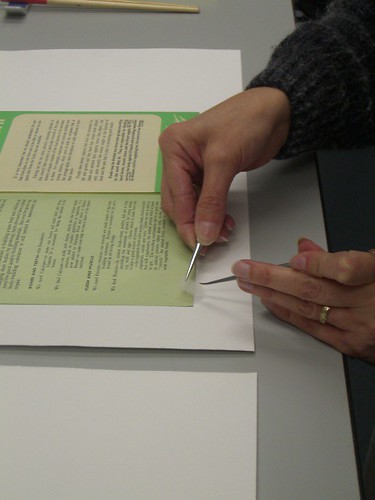
Repairing
Tina Kelly is using wheat starch paste to attach Japanese Tengujo tissue to repair a small rip at the edge of this pamphlet. The tissue acts like sticky tape, preventing the tear from ripping further into the page.

Cleaning

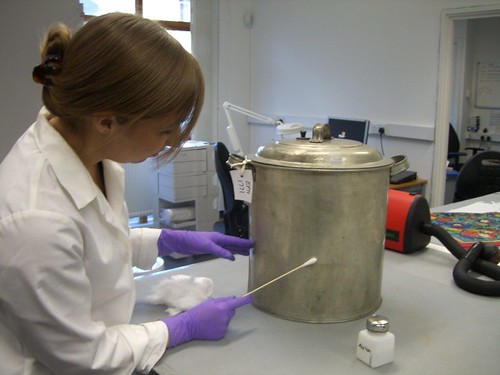
Cleaning
When bringing the boiler out of storage, the Conservation team found that someone had covered the entire surface in sticky grease and wrapped it in greaseproof paper. Joanna Cook, above, has been hard at work with a bottle of acetone and a cotton swab, removing the grease and getting the boiler ready for display.

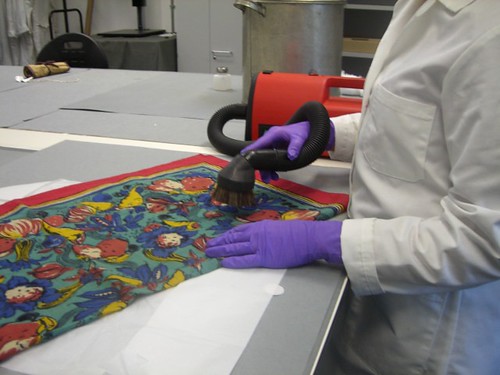
Museum Vac in action!

Museum Vac in action!
Looking after fabrics requires careful work. The scarf has to be carefully vacuumed using a special low suction ‘Museum Vac’ to remove dust and any remnants of old pest damage. Dust is particularly harmful to fabric - it can attract pests, can cause staining and can damage delicate fibres.

Labels: , , , , , , ,

Sunday, February 20, 2011

Close and Medium Reconnaissance

Mark from The Winter Of '79 answers my question about the designation of reconnaissance units in the British Army; What is the difference between close reconnaissance and medium reconnaissance.

Hi Scott

The Medium Recce finds the enemy. Close Recce defines the extent of the enemy or nature of obstacles at any given site by getting up close and personal.

Cheers
Mark

Labels: ,

Thursday, March 04, 2010

BBC: WW2 People's War is an amazing collection of stories

The BBC has a really amazing collection of stories from people that lived through the second world war. They are first hand accounts and they are great reads. They are not just from soldiers but from all kinds of folks. The stories offer incredible insights into the lives of ordinary people in wartime. I just finished reading one that was written by a Churchill tank driver/mechanic named Frank Meredith. He spent much of his time in the 9th Battalion of the Royal Tank Regiment, often driving a Churchill tank named IMMUNE II.

"I didn't find the name very encouraging. What had happened to IMMUNE I?"

CLICK HERE to read Frank Meredith's whole story.

Between June 2003 and January 2006 the BBC collected 47,000 stories and 15,000 images. CLICK HERE to go to the project's homepage.

I quite wonder if any organization in the US collected stories on this scale.

Labels: